Coming soon · Atlassian Marketplace

Your center of gravity for requirements in Jira.

Grava is the requirements platform Jira deserves. It brings requirements engineering, MBSE, traceability, structured specs, and reviews directly into your workflow, with AI specialists for each part of the work. Built for safety-critical teams in automotive, aerospace, and medical device.

Built for Jira Cloud| ISO 26262 · ASPICE · 21434| Audit-ready
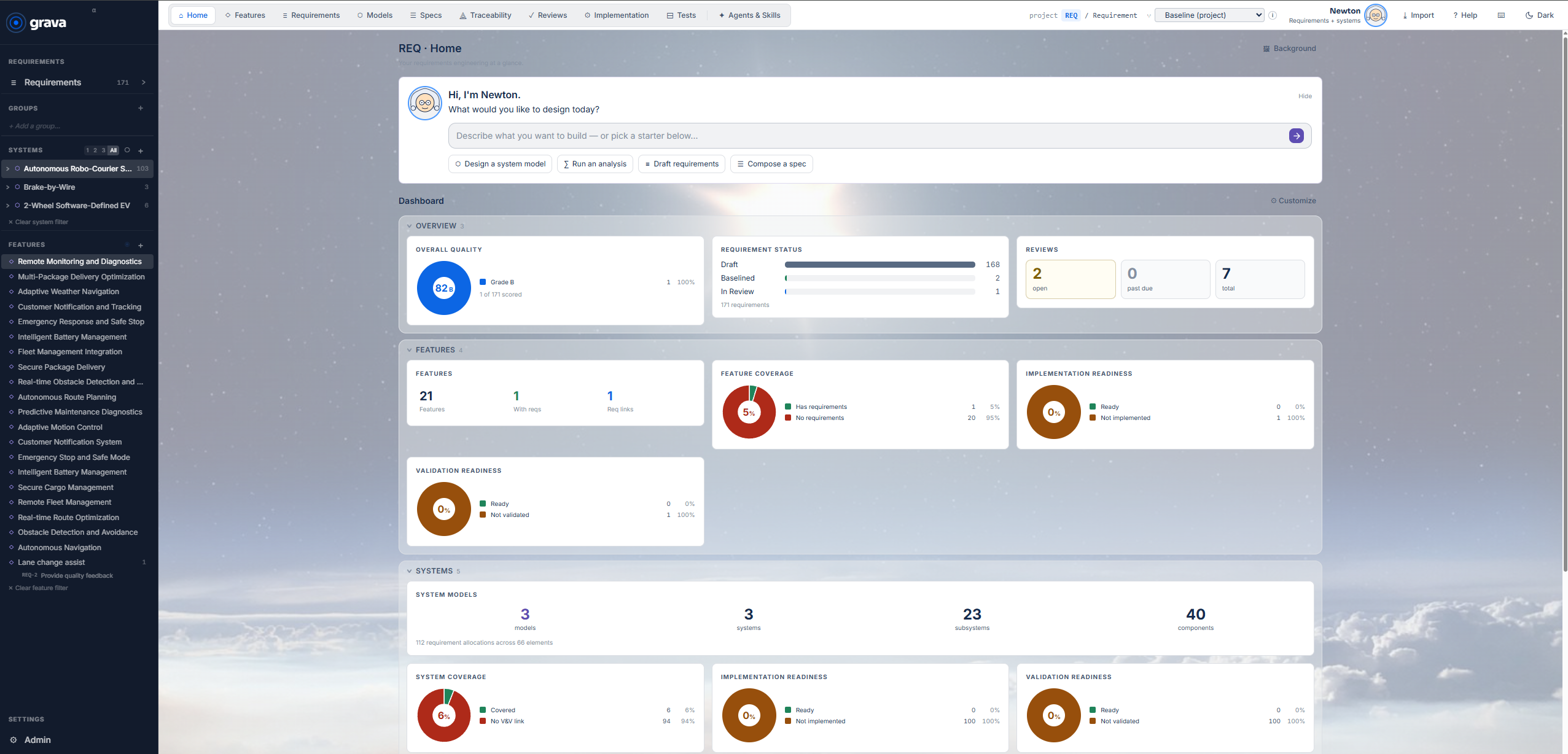
Grava dashboard showing quality grade, requirement status, reviews, feature coverage, and system readiness
RequirementsQuality · types
MBSESystems · analyses
TraceabilityEnd-to-end
SpecsRich documents
ReviewsFormal workflow
ComplianceStandards-aware
Why this exists

Engineering happens in Jira. Everything else lives somewhere else.

Today's requirements stack is fragmented, clunky, and expensive. Teams pay six figures for tools that don't talk to each other, then build the integration glue themselves. Grava brings the work back together where it belongs.

Problem 01

Execution lives in Jira. Everything else lives outside the box.

Enterprises spend hundreds of thousands of dollars annually on requirements, modeling, and compliance tools that sit outside their execution platform. Most are decoupled, require significant integration to keep data aligned, and break the moment a field schema changes. In Grava, your requirements live with your execution. One tool, one source of truth, no integration tax.

Problem 02

Legacy RM tools are powerful. And painful to use.

The established requirements management tools have real capabilities, but they're heavy, slow, and saddled with steep learning curves. New hires lose weeks before they're productive. Grava's AI-assisted workflows compress that ramp from weeks to days. Your team is drafting, scoring, and tracing requirements on day one.

Problem 03

Stop choosing your own adventure on compliance.

Industry standards, base practices, and compliance frameworks are prescriptive for a reason, but teams still reinvent the wheel with custom data models, ad-hoc workflows, and home-grown templates. Grava ships with industry-standard scaffolding for ISO 26262, ASPICE, and ISO/SAE 21434, so you start with the right structure instead of fighting your own.

The platform

Everything you need. Where the work already happens.

Grava turns Jira into a serious requirements platform, not by replacing it but by adding the structure, intelligence, and discipline that requirements work actually requires.

Requirements Core

Real requirements management. Native to Jira.

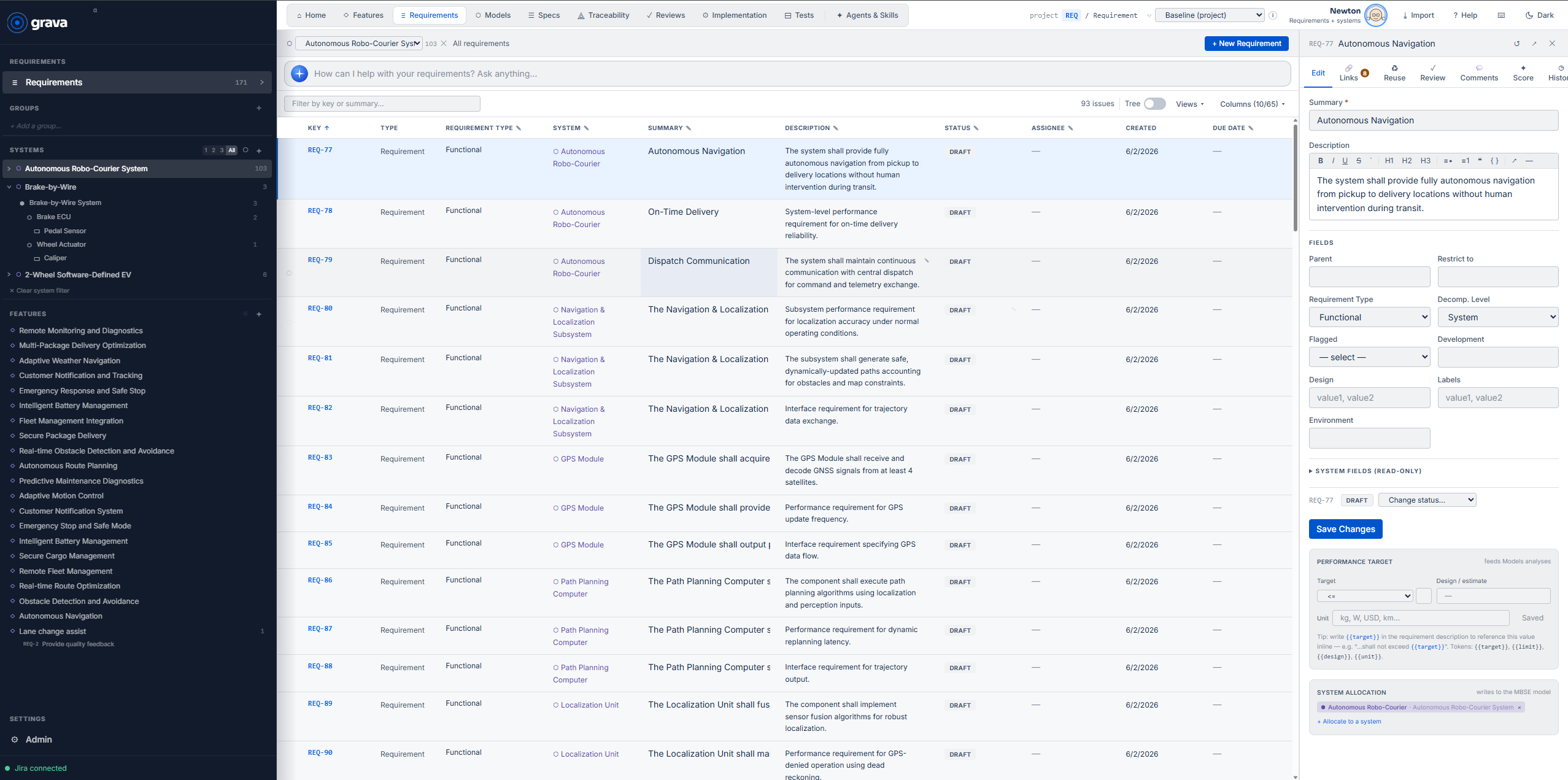
Requirements live as first-class Jira issues with the structure they deserve: typed fields, decomposition levels, system allocation, performance targets, and version history. Editable in a familiar issue panel, queryable with standard JQL, visible to every tool already in your stack.

  • Rich requirement schema: type, decomposition level, environment, design constraints, labels, performance targets
  • System allocation: link requirements to your MBSE model, with the allocation reflected in the system view
  • Performance targets that feed analyses: write a constraint once, validate it in your Models analyses
  • Change-aware history: every edit logged, every status transition tracked
Grava requirements table with rich field model, system allocation, and side-panel detail editor
REQ-77 · Autonomous Navigation · system allocation visible inline
Models Core

Model-Based Systems Engineering, integrated.

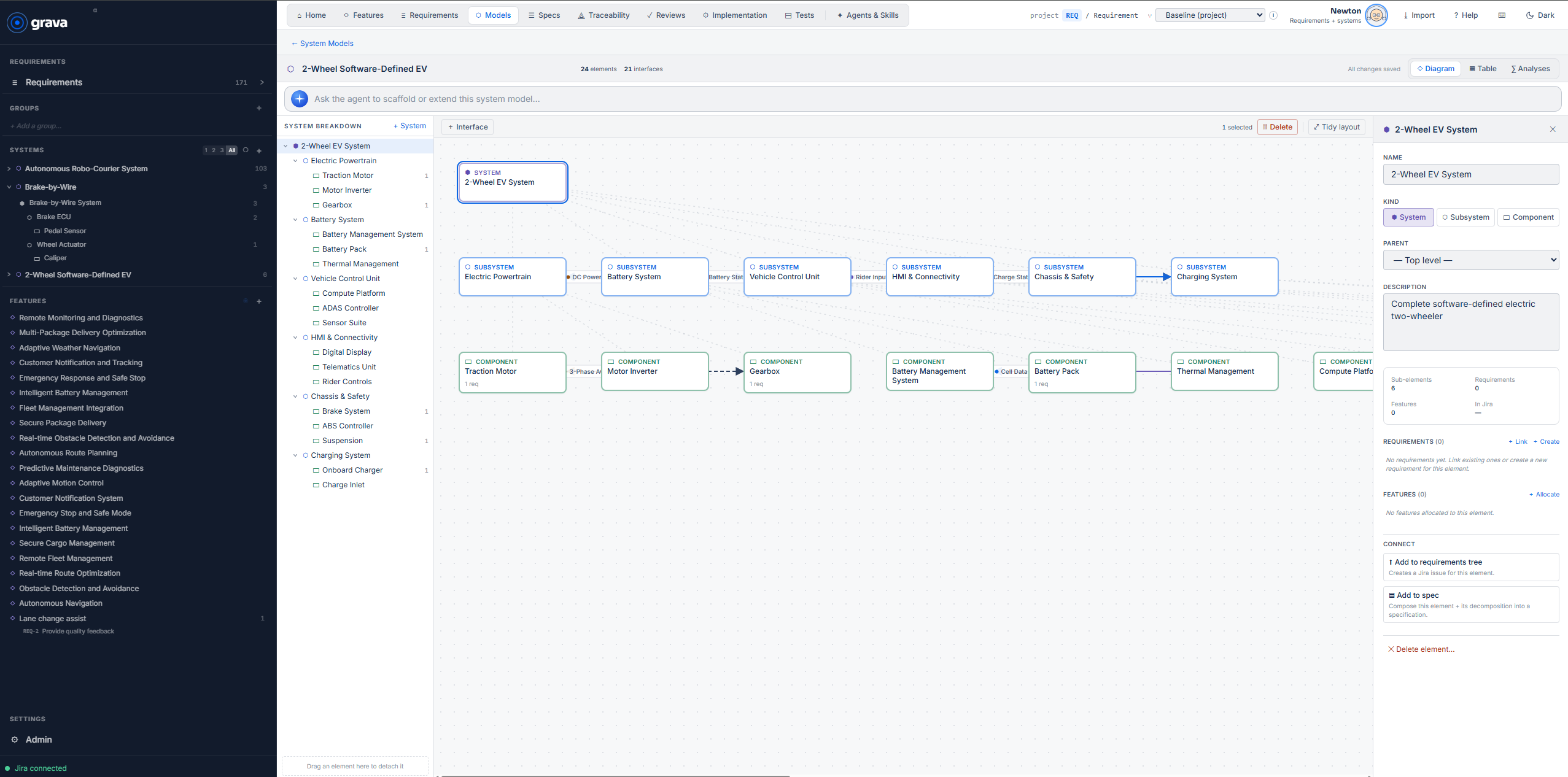
Decompose your system into subsystems and components with physical interfaces. Run customizable analyses (mass roll-ups, cost roll-ups, power budgets, range estimates, battery sizing) that check against requirement targets and either pass or fail.

  • System breakdown: hierarchical decomposition with kind labels (System / Subsystem / Component) and parent/child traceability
  • Physical interfaces: connect elements through real signals (DC Power, CAN, sensor data) visible on the diagram
  • Configurable analyses: template, describe in natural language, or write Python. Your choice.
  • Requirement checks: analyses validate against requirement performance targets; results are baselined as evidence
  • Evidence & review: analysis snapshots are auditable artifacts, exportable to PDF, traceable to the version that produced them
Grava MBSE view showing system decomposition with subsystems, components, and physical interfaces
2-Wheel EV System · 24 elements · 21 interfaces
Traceability Core

End-to-end traceability. Live, not exported.

Requirements link to work items, test cases, and defects through industry-standard relationships: satisfaction, implementation, validation. Coverage is computed live, gaps are surfaced explicitly, and suspect links (where source or target changed) are flagged with a diff so you can review the impact.

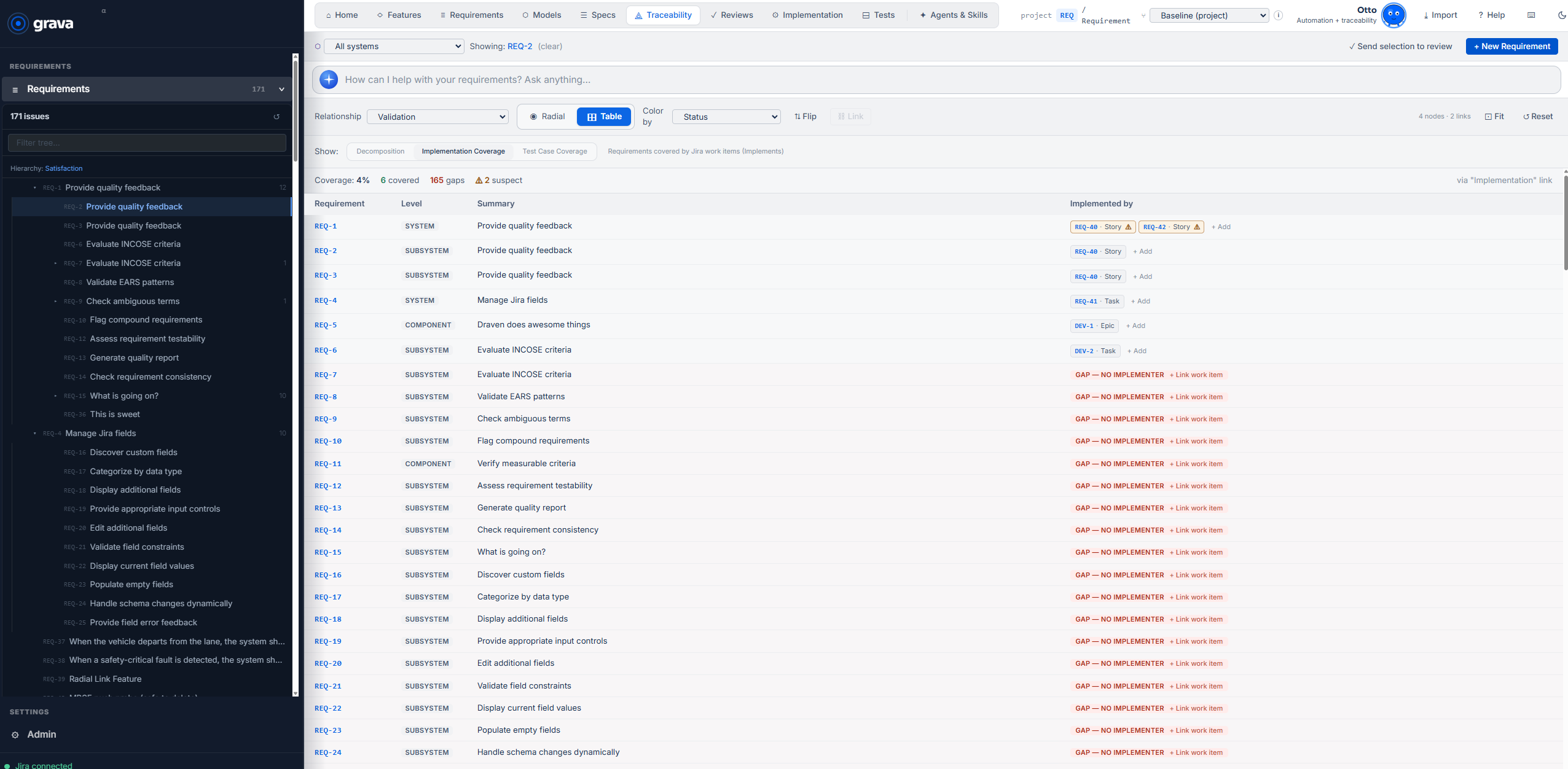
  • Implementation coverage: requirements linked to Jira work items, with gap detection and red-flagged "no implementer" states
  • Test coverage: requirements linked to test cases via validation relationships
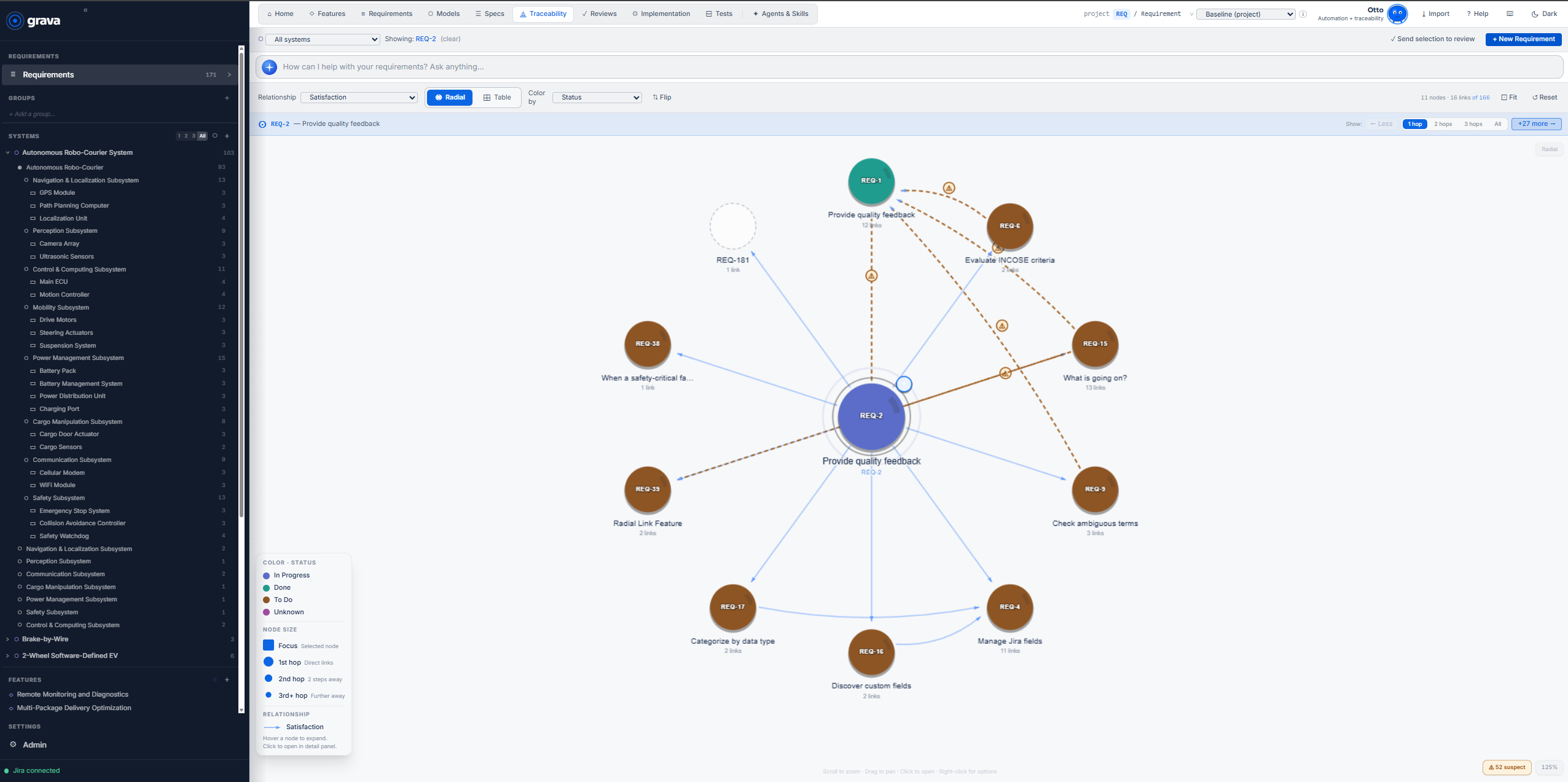
  • Radial trace graph: visualize any requirement's neighborhood with configurable hops, color-by-status, and node sizing
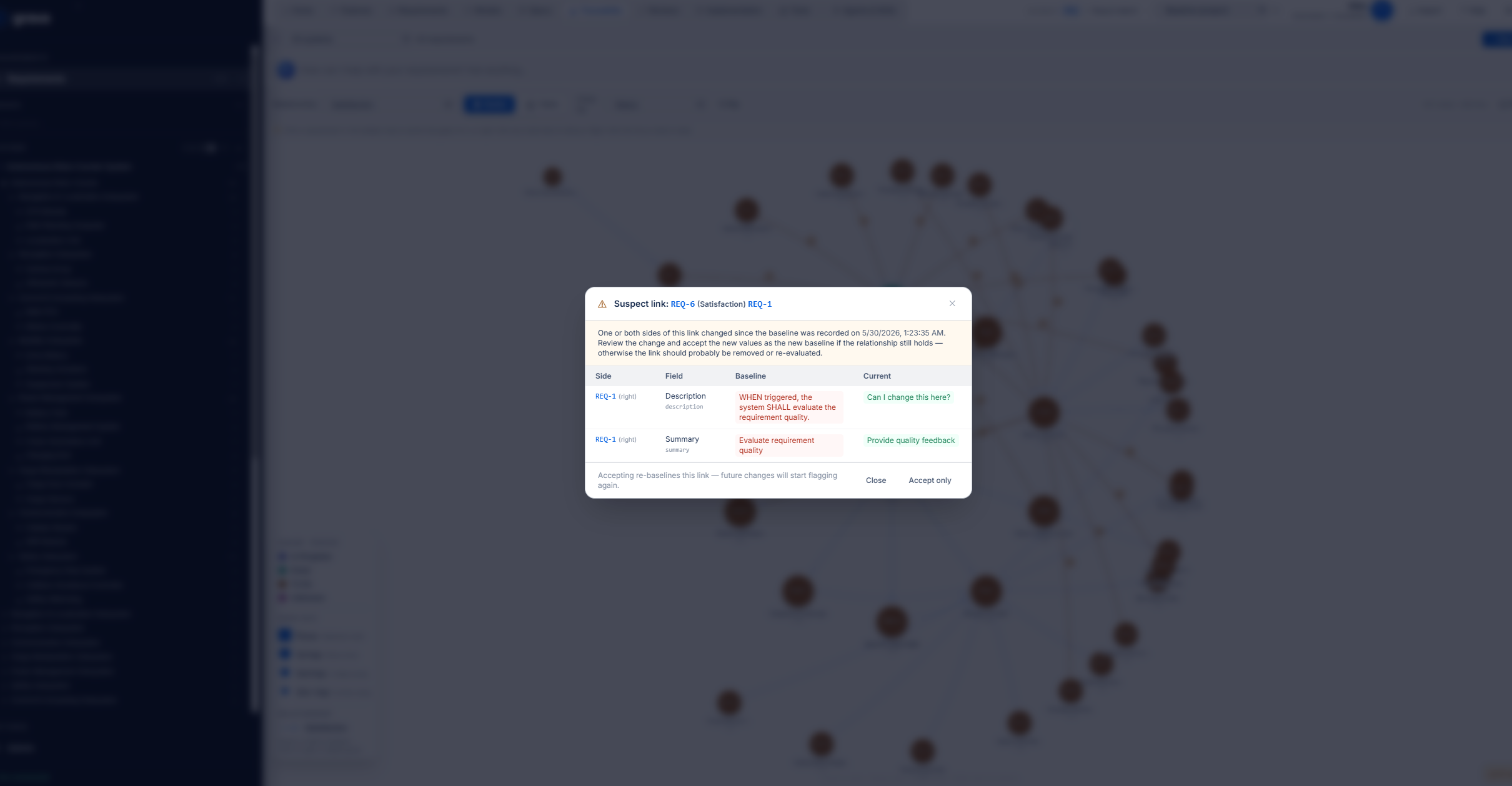
  • Link validity: suspect links flagged when either side changes, with a diff to analyze the change before approving or breaking the link
Grava radial traceability graph centered on a requirement with linked items expanded by hop count
REQ-2 · 11 nodes · 16 links · radial expansion to 1 hop
Specs Core

Structured specifications. With everything inline.

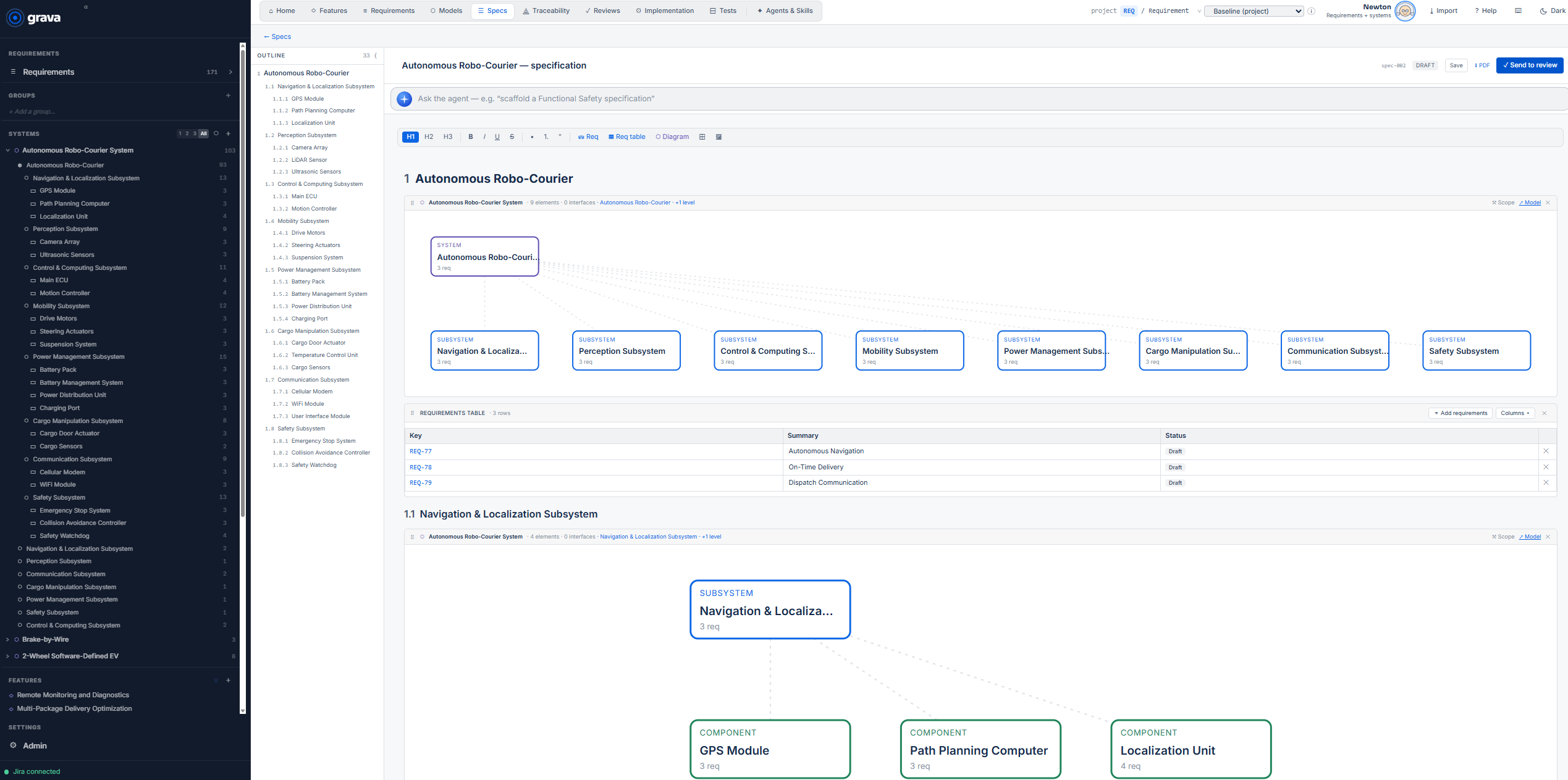
Compose specifications that mix rich prose, headings, tables, images, requirement tables, and embedded MBSE models. This is the format your reviewers and auditors expect, generated from the data already in your platform. Send to review, export to PDF, baseline as a snapshot.

  • Living documents: requirements and MBSE diagrams embedded inline update as the source changes
  • Outline navigation: multi-level headings with auto-numbering and navigation tree
  • Requirement tables: drop in a filtered set of requirements as a structured table
  • Review workflow: send specs to review as a single artifact; capture approvals; export as PDF
  • Audit-ready exports: every spec snapshot is reproducible from the data that produced it
Grava spec composer showing structured outline, embedded MBSE diagrams, and requirement tables in a single document
Autonomous Robo-Courier · specification draft · embedded system diagrams
Reviews Core

Formal reviews. Real evidence.

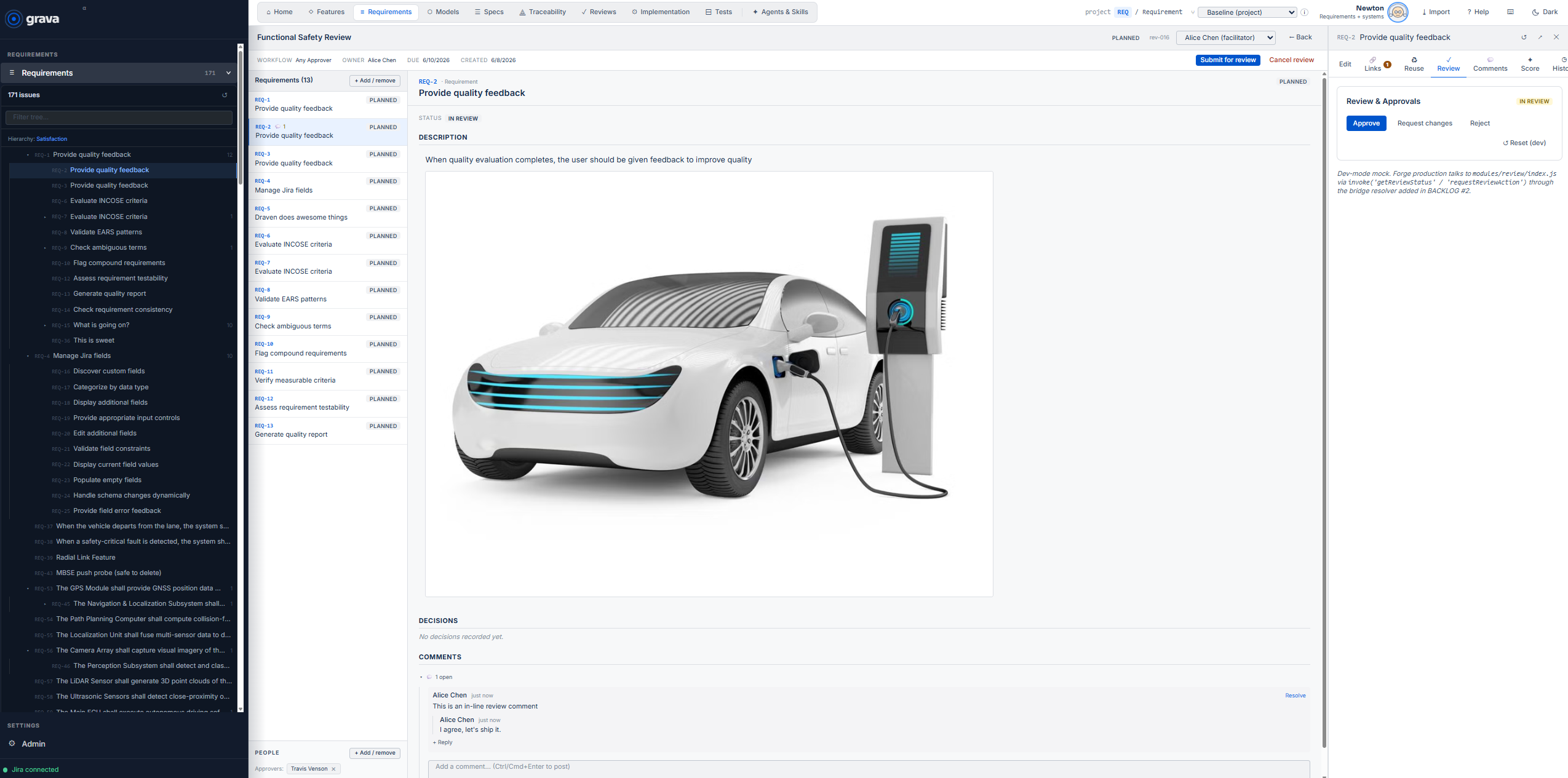
Structured review cycles with planned/in-review/approved states, configurable approval workflows, multiple reviewers, in-line comments, and recorded decisions. This is the audit-grade evidence that safety reviewers and ASPICE assessors expect, generated as a natural byproduct of the work.

  • Configurable workflows: any approver, all approvers, or quorum-based approval rules
  • Per-requirement state: track review progress at the artifact level, not just the meeting level
  • In-line comments and decisions: discussion captured against the artifact, with resolution tracking
  • Attachments and rich context: supporting documents, images, and diagrams live alongside the review
  • Reviewer assignment: facilitator, approvers, and stakeholders managed per review
Grava formal review screen with requirement list, in-line comments, decisions, and approval state
Functional Safety Review · rev-016 · 13 requirements · facilitator-led
Dashboards Core

The view program managers actually want.

Configurable dashboards with templates for the questions that matter: overall quality grade, requirement status breakdown, review counts, feature coverage, implementation readiness, validation readiness, and system coverage roll-ups. At a glance, with drill-down to the underlying data.

  • Quality grade: letter-grade summary of requirement quality across the project
  • Status breakdown: draft vs. baselined vs. in-review counts, with trend
  • Feature coverage: which features have requirements; which features are implemented
  • Implementation & validation readiness: what's ready, what isn't, where the gaps live
  • Customizable templates: drop in the widgets that match your reporting cadence
Grava configurable dashboard with quality grade, status breakdown, feature coverage, and system readiness metrics
Project REQ · 171 requirements · 3 system models · 23 subsystems
Change & impact Core

Suspect links, flagged with a diff.

When a requirement, test, or work item changes, every link to or from it is flagged as suspect, and a diff shows exactly what changed. Review, approve, or break the link. No more silent drift. No more audit-day discoveries.

  • Bidirectional suspect-link detection: change either side, both sides know
  • Inline diff: see exactly what changed and decide what to do
  • Bulk impact analysis: find every artifact affected by a proposed change before you make it
  • Change traceability: every link state transition logged for audit
Grava impact analysis view showing suspect links and change diff between requirement versions
Impact analysis · suspect link review · before / after diff
Features & product line Core

Feature-driven development. Product line aware.

Manage your product's feature set as first-class artifacts. Allocate features to systems, link them to requirements, and roll up implementation status across vehicle lines. Built for product-line engineering with baselines, variants, and referential reuse. The way real automotive programs actually work.

  • Feature catalog: features as first-class artifacts, allocated to systems and linked to requirements
  • Baselines: immutable snapshots of requirement, model, and feature state, captured on demand
  • Variants: reuse requirements across vehicle lines without copying; overrides applied as a layer
  • Referential reuse: change the source, all referencing variants inherit; explicit overrides surface clearly
  • Drift detection: when a variant's overrides accumulate, the platform tells you to consider detaching
Grava feature and traceability coverage view with gap detection across implementation links
Implementation coverage · 4% · 6 covered · 165 gaps · 2 suspect
The intelligence layer

Five AI specialists. Working on your real Jira issues.

Grava's agents aren't a chatbot bolted onto a dashboard. Each specializes in a part of requirements work, runs configurable skills on real Jira data, and presents every output as a reviewable draft. Nothing auto-applies to your specification.

Newton
Requirements + systems

Ask Newton anything about your specification or system. He drafts requirements in IREB-quality / EARS format, scaffolds system models, runs analyses, and explains the whole stack in your own vocabulary.

draft model analyze explain
Claire
Quality + reviews

Claire scores requirements on clarity, completeness, and testability. She calls out ambiguity, weasel words, and untestable language, facilitates reviews, and stamps her seal only on what passes.

score review approve
Otto
Automation + traceability

Otto decomposes requirements into testable children, links them through the V-model, and maintains the trace graph live. When something changes, he tells you exactly what's affected and what to retest.

decompose link impact
Vera
Test + verification

Vera turns requirements into test plans, finds gaps in coverage, and tracks verification status across the V-model. She'll tell you which requirements have no tests and which tests have nothing to verify.

test plans coverage DVPR
SENTINEL
Sentinel
Standards + compliance · the crest

Sentinel watches the work against the standards. ASPICE, ISO 26262, AIAG-VDA, ISO/SAE 21434: she knows the clauses and can show you exactly where a requirement, test, or trace doesn't meet them. As you add safety/cyber modules, her shield earns more stars and her expertise grows. Learn more →

ASPICE ISO 26262 AIAG-VDA ISO/SAE 21434 audit-ready evidence
!

AI proposes. You decide. Every time.

Grava's agents draft, score, decompose, and analyze. But every output is a labeled, reviewable proposal. Nothing auto-applies to your specification. Nothing bypasses human review. For teams whose work has audit consequences, that distinction isn't a footnote. It's the foundation.

Modular by design

Start with the core. Add what you actually need.

Grava ships as a complete requirements platform with MBSE, traceability, specs, reviews, and dashboards in the core, then layers in domain modules for the safety, cyber, and process disciplines that demand real rigor.

Requirements + Models

Core · always on

Requirements engineering, MBSE, analyses, traceability, structured specs, reviews, dashboards, and four AI agents. Everything you need to run a requirements program in Jira.

Led by Newton, Claire, Otto, Vera

FMEA

Add-on · post-launch

Design and Process FMEA aligned with AIAG-VDA. RPN calculation, failure-mode libraries, action tracking, and links from failure modes to the requirements they affect.

Unlocks ★★ Sentinel

Cybersecurity

Add-on · post-launch

ISO/SAE 21434 workflows: TARA, threat modeling, cybersecurity goals, and cyber-aware requirements with traceable links to controls.

Unlocks ★★★ Sentinel

Functional safety

Add-on · post-launch

ISO 26262 workflows: HARA, ASIL allocation, safety goals, technical safety requirements, and the full safety case with audit-ready evidence on demand.

Unlocks ★★★★ Sentinel

Test Suite

Add-on · post-launch

Test plans, test execution, automation hooks, results capture, and defect management. Closes the V-model loop with verification evidence linked back to the requirements it satisfies.

Expands Vera · Otto

ASPICE Readiness

Add-on · roadmap

Continuous indicators of how your data trends against ASPICE-relevant practices. A preparation tool, not an assessment, that helps your team arrive better prepared.

Hosted by Sentinel

Data Center / self-hosted

Add-on · roadmap

For regulated buyers who can't put requirements in the cloud. Self-hostable deployment with a configurable AI endpoint so requirements never leave your environment.

Deployment option
SENTINEL
Sentinel · the crest

One agent. Every standard your team is held to.

Sentinel is Grava's standards expert. She knows the clauses, names the practices, and shows you where your data trends against the bar an auditor will use. She doesn't replace the assessor; she helps you arrive prepared.

As your team adds add-on modules, Sentinel's shield earns more stars and her domain expertise expands. From a single agent covering automotive baselines, to a fully-leveled compliance partner spanning FMEA, cybersecurity, and functional safety.

Standards
★★
+ FMEA
★★★
+ Cyber
★★★★
+ FuSa
How Grava works

Discover Jira. Import requirements. Run a real program.

Grava installs as one Marketplace app. You discover your existing Jira projects, configure the data (what's a requirement, what's an implementation, what's a test), and the platform turns it into a coherent requirements program.

01 · Discover

Connect your Jira

Grava discovers your existing projects and lets you configure which work items are requirements, which are implementation, which are tests, and which are defects. Your existing data becomes a real specification.

02 · Model

Build the system

Decompose your product into systems, subsystems, and components. Define physical interfaces. Allocate requirements to elements. Run analyses that check against requirement targets.

03 · Trace

Link the work

Connect requirements to features, work items, test cases, and defects through industry-standard relationships. Otto maintains the trace graph live; suspect links surface with a diff.

04 · Comply

Watch the standards

Sentinel maps your work to the relevant clauses of your enabled standards. Reviews capture evidence. Specs export to PDF. Audit-ready evidence flows from the work itself, not a parallel binder.

Why Grava

Built by safety-systems engineers for safety-systems engineers.

Most requirements tools were built for general PM teams and bolted compliance on later. Grava is built the other way around.

Jira is the source of truth

No parallel database. Your requirements remain Jira issues, audit-visible, queryable by JQL, and usable by every other tool in your stack. Grava adds the structure, intelligence, and discipline. Not another data silo.

AI proposes, humans decide

Every AI output is a reviewable draft: labeled, sourced, and held back until you approve. Nothing auto-applies to your specification. Validation over generation, every step.

Standards are first-class

ASPICE, ISO 26262, ISO/SAE 21434, AIAG-VDA aren't checkbox features. They shape the data model, the workflows, and the audit exports. Sentinel cites the clause.

Designed for 100k+ requirements

The architecture handles enterprise-scale catalogs from day one: paginated views, pre-computed rollups, async heavy analysis. No "we don't recommend more than a few thousand."

Modular pricing, modular product

You're not forced into a "safety suite" you'll use 20% of. Start with the core; add FMEA, Cyber, or FuSa when you actually need them. Sentinel levels up as you do.

Deployable where you need it

Cloud-first via the Atlassian Marketplace. For regulated customers who can't put requirements in the cloud, a self-hostable deployment for Data Center environments is on the roadmap.

Common questions

The honest answers

"Isn't this just Jira with extra fields?"

It's Jira with the structure, AI, traceability, MBSE, specs, reviews, and standards expertise that Jira itself doesn't try to give you. The reason teams pay six figures for separate requirements tools is exactly that. Jira out of the box can't do this work. Grava brings that capability inside Jira instead of forcing you to leave it.

"How does this compare to Jama, Polarion, or DOORS?"

Those tools are powerful but expensive, slow, and disconnected from where engineering work actually happens. Grava starts from Jira (the tool your team is already in) and adds the requirements-platform capabilities that legacy tools sit in. The result: less double-entry, less spreadsheet, less audit panic.

"Does Grava do MBSE, or just requirements?"

Both. Grava includes a working MBSE module: system decomposition with subsystems and components, physical interfaces, requirement allocation, and configurable analyses (mass roll-ups, cost roll-ups, power budgets, range estimates, battery sizing) that validate against requirement performance targets. It's not a SysML editor and doesn't try to be; it's the MBSE most teams actually need.

"Can I trust AI on a safety case?"

Grava's AI never auto-applies anything to your specification. Every suggestion is a labeled draft, with reasoning, that a human reviews and accepts or rejects. Sentinel cites the clause she's matching against. The product is built around validation, not automation. The engineer is the decision-maker.

"What can Sentinel actually do?"

Sentinel observes the artifact-side evidence in your Grava workspace and trends it against ASPICE-relevant base practices, ISO 26262 expectations, and other standards on her current rank. She helps you arrive at an assessment better prepared by showing you where your requirements, traces, reviews, and changes line up with what assessors look for, and where the gaps are. She's a preparation tool, not a replacement for a qualified assessor.

"How does product line management work?"

Baselines snapshot requirement, model, and feature state at a moment in time. Variants reuse requirements across vehicle lines through references. Change the source, and all referencing variants inherit. Explicit overrides apply as a sparse layer. Drift detection surfaces when a variant's override percentage gets high. No copy-paste, no spreadsheet maintenance, full traceability across lines.

"What about my data privacy?"

Grava runs as a Forge app inside Atlassian's secure infrastructure. AI calls go through a configurable endpoint. By default it routes to Anthropic's API; for regulated customers, this can be swapped to a private deployment so requirements text never leaves your environment. We never train models on your data, and full data residency controls are on the roadmap for Data Center customers.

"What does pricing look like?"

Per-user pricing through the Atlassian Marketplace for the core platform; add-on modules (FMEA, Cybersecurity, Functional Safety) priced separately. The pricing model is built so a small team can adopt the core at low cost, and only customers actually doing FuSa pay for FuSa. Final pricing announced at launch.

"Is Grava open source?"

No. Grava is a commercial Marketplace app. The methodology and standards-mapping work it builds on (EARS, IREB, ASPICE, ISO 26262) are open and well-documented; our value is in the product implementation, not in restricting access to the underlying ideas.

"When is it available?"

Grava is in active development with a working alpha. We're starting design-partner conversations now and targeting an Atlassian Marketplace launch in the months ahead. Join the waitlist for early access and to be first to know when alpha opens.

"What about Data Center / self-hosted Jira?"

Cloud is the first target. A self-hostable deployment for Data Center and air-gapped customers, including a configurable AI endpoint so requirements don't leave your environment, is on the roadmap. If this matters to you, tell us in the waitlist form and we'll prioritize accordingly.
Join the waitlist. Help shape what gets built.

Early access to the Marketplace launch, plus invites to design-partner conversations that shape the product.

Building in public · we'll write when there's something real to say